· Updated
UK mosque shoe racks and rainy-day etiquette for guests
How guests at UK mosques handle wet shoes, umbrellas and crowded racks so entrances stay clear, elders can move, and prayer-hall floors stay safe.
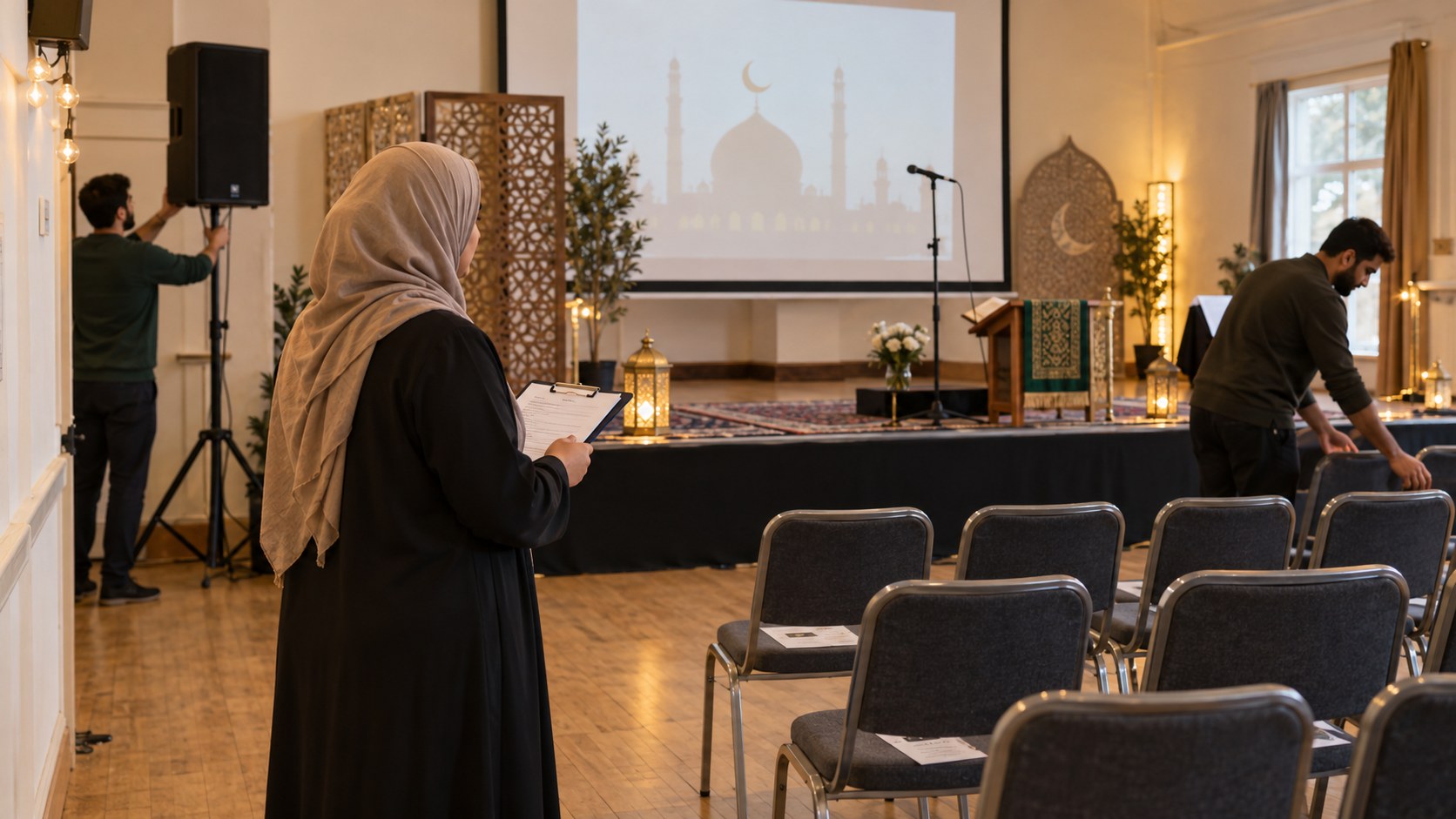
British rain turns a mosque doorway into a logistics problem before the first takbir. Wet soles glaze tiles, collapsed umbrellas drip into the rack, and a guest who means well can still block the door while hunting for a free cubby. Etiquette here is not theatrical reverence. It is making sure the next person can enter without slipping, and that the exit remains usable if something goes wrong.
Follow the house rules posted at the door of the mosque you actually attend. This article is for guests, parents with muddy children, and anyone who arrives mid-rain to a Friday rush. It is not a facilities manual for mosque committees, though some of the same safety instincts apply to anyone who shares an entrance.
Why the rack is part of safety, not only manners
Shoes pile up where people arrive. In a packed jama'at that is often the same threshold people will use to leave. Fire-safety guidance for places of worship treats clear escape routes as non-negotiable. GOV.UK's guide to fire safety risk assessment for small and medium places of assembly covers churches and other places of religious worship or study among premises that may hold up to a few hundred people. Guests are not the "responsible person" for the building's formal assessment, but they still control whether their pair, bag, or buggy sits in a doorway that must stay open.
Think of the rack as shared infrastructure. A neat row of soles-down pairs is courtesy. A sprawl of trainers across a fire-exit mat is a hazard. Volunteers who redirect traffic are usually protecting both prayer and egress, not inventing arbitrary rules. If a steward asks you to move a bag or collapse an umbrella, do it without a debate about parking theory.
Congestion after salah is predictable. People want shoes, phones, and conversations at the same moment. The guest who already knows where their pair is, and who steps aside to put it on, shortens the jam for everyone behind them. That is etiquette with a safety dividend.
Arrive with a plan for water
Carry a thin shoe bag or tote when the forecast is grim. Place wellies and trainers where the rack or shelf is marked, soles down, not stacked on someone else's dress shoes. Shake umbrellas outside. Leave them in the stand or drip tray if one exists rather than opening them over the prayer-hall threshold. If there is no stand, fold the umbrella closed and park it where water can pool without turning the shoe shelf into a pond.
Wipe the worst mud on the outdoor mat before you reach the rack. A trail of grit through carpet is harder to forgive than a delayed greeting. Grit also becomes a skating hazard once it mixes with rainwater on hard floors. If the mat is already saturated, stamp once outside and accept that your shoes will still be damp; the bag exists for that reason.
If you are new, watch for thirty seconds before inventing a system. Some mosques separate men's and women's entrances. Some ask guests to keep bags clear of marked exits. Some number the racks. A volunteer's quiet gesture beats a loud argument about "how we do it back home." Diaspora mosques are not replicas of a childhood courtyard; they are British buildings with British weather and posted rules.
Where to put what when the shelf is full
When the lowest shelves are taken, use higher ones if you can reach them safely, or place pairs neatly against a wall that is not an exit route. Do not claim the entire bottom row for one family of five. Leave the easiest shelves for elders, people with mobility aids, and anyone carrying a child. Offer to move your pair higher if someone older arrives behind you.
Keep plastic bags and wet jackets off the floor in the middle of the corridor. Hang coats on hooks if provided. If you must hold an umbrella while you remove shoes, step aside so the queue can pass. The goal is flow: one person finishes, the next starts, nobody performs a full wardrobe change in the choke point.
If the rack is genuinely full, ask a steward where overflow goes. Do not start a second pile in front of a double door because it "looks temporary." Temporary piles become permanent obstacles the moment the adhan starts and attention shifts.
Socks, slippers, and temporary footwear
Guests unsure about socks or temporary slippers should ask quietly rather than improvising in the middle of the doorway. Some halls expect bare feet on carpets; others are fine with clean socks. If your socks are soaked from the walk, change into a dry pair from your bag before you enter the prayer space. Wet socks on carpet transfer dirt and smell that linger after you leave.
Do not leave expensive trainers in the aisle "so you can find them faster." Mark your bag with a discreet tag if the rack is chaotic. When you leave, reclaim your shoes quickly so the rush after salah does not become a pile-up. The people behind you are not a secondary concern; they are the congregation you just prayed with.
If you borrow communal slippers, return them where the mosque asks. Do not walk them into toilets and then back onto the prayer carpet. House hygiene rules exist because hundreds of feet share the same fibre every week.
Umbrellas, pushchairs, and Friday peaks
Friday and Eid peaks compress everything. Arrive a few minutes earlier if rain is forecast so you are not negotiating shelf space during the adhan. If you bring a pushchair, park it only where stewards indicate. A buggy blocking a double door is a bigger problem than a misplaced shoe. Collapsible umbrellas belong in stands or bags, not open across cubbies.
If you are hosting a guest who has never visited a UK mosque, brief them before the door: shoes off here, bags there, follow the volunteer, do not film people without consent. Courtesy is the soft infrastructure of a diaspora mosque. The rack works when people treat it as shared property, not a race.
Large family groups should stagger at the threshold rather than arrive as a wall of eight people removing shoes at once. Two finish, two start. The people praying inside should not hear a doorway argument about whose wellies go where.
Wet floors, elders, and the walk from car to carpet
Rain does not stop at the mat. Water tracked onto hard lobby tiles is a slip risk for elders and for anyone carrying a child. If you see a spill you caused, wipe it or tell a steward. If the lobby has paper towels or a mop nearby, use them without waiting for someone "official" to notice. Guests share responsibility for the last ten metres of journey.
Offer an arm if an older relative is unsteady on wet tiles. Carry their bag so they have a free hand for the rail. These are small acts, but they matter more than a perfect shelf arrangement. Etiquette that only polices children while ignoring elders has misunderstood the room.
Rainy Eid and other peak days
Eid mornings multiply every ordinary Friday problem. Families arrive in clusters, children carry novelty shoes they cannot manage alone, and stewards are already stretched thin. If you know Eid will be wet, pre-bag shoes at home and assign one adult to doorway logistics while another settles elders inside. Do not treat the entrance as a photo backdrop while people behind you wait barefoot on wet tiles.
Outdoor overflow prayers and marquee setups, when used, create their own shoe lines on grass or temporary flooring. GOV.UK assembly guidance reminds organisers that temporary structures need safe egress over uneven ground. As a guest, that means keeping personal gear out of marked exit lanes even when the "building" is a tent peg line. Follow stewards. Do not invent a second shoe wall in front of the only clear path back to the car park.
What guests should not invent
Do not rearrange the entire rack to suit your system. Do not scold strangers for using a different shelf. Do not leave notes on other people's shoes. If something is genuinely unsafe, a blocked exit, a spill on tiles, alert a steward or committee member rather than staging a confrontation in the doorway. Your job as a guest is to leave the entrance better than you found it: drier, clearer, and free of your gear.
House rules beat social-media etiquette lists. If a mosque asks men and women to use different doors, do that. If it asks for shoes in numbered racks, use the numbers. If it asks guests to keep phones silent in the hall, keep them silent. The rain will still be there when you leave. The person behind you should not have to wade through your puddle to pray.
A good rainy-day visit is forgettable in the best sense: you arrived, you managed water, you prayed, you left space for the next person. The rack does not need your philosophy. It needs your pair, bagged, soles down, out of the exit line.
Sources and official profiles
Filed under
Was this helpful?
Keep reading
Related stories
More from this desk, this beat, and the tags on this piece.
A nikah in England is not automatically a civil marriage: check the legal registration
Bilal Ahmed · 28 Oct 2026

Urdu and Panjabi in England and Wales: what Census 2021 language data shows
Bilal Ahmed · 28 Oct 2026


Sending money from the UK to Pakistan: compare the amount received, not the fee alone
Bilal Ahmed · 20 Oct 2026

Eid gifts for children without turning the house into a toy warehouse
Bilal Ahmed · 12 Oct 2026
British Pakistanis in Census 2021: what the 1.59 million figure actually means
Bilal Ahmed · 12 Oct 2026
Readers
The conversation
0 notes
Anyone can leave a note. Guests add a name and email — no account required, and the email is never published.
No notes yet. Yours would be the first.