Sherwani, achkan and prince coat: three formal menswear silhouettes, not synonyms
Sherwani, achkan and prince coat are often grouped together in wedding retail, but the differences in length, structure, overlap and styling change the whole silhouette.
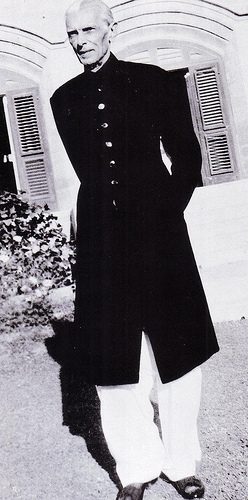
Pakistani wedding shops often place sherwani, achkan and prince coat on the same rail and let embroidery do the naming. The silhouettes are related but not identical. Length, front closure, flare and historical styling all change how the garment reads on the body.
Museum collections show the long history of fitted court and formal coats across South Asia, while modern Pakistani tailoring has developed its own wedding categories. The boundaries are not policed by one universal fashion authority, so construction is more useful than labels.
The sherwani silhouette
A sherwani is usually a long, structured formal coat with a stand collar and full front closure, commonly reaching around the knee or below. Wedding versions may be heavily embroidered or cut from brocade.
The longer line creates visual authority but also makes trouser choice, shoe height and coat fit more consequential.
What makes an achkan feel different
Achkans are often cut somewhat shorter and can be more fitted through the body, with a cleaner or more tailored line. Historical and regional usage varies, and some modern retailers use achkan for almost any fitted formal coat.
Rather than arguing terminology, compare actual hem, flare and closure.
The Pakistani prince coat
Prince coat is a contemporary retail category in Pakistan for a structured formal jacket, often shorter than a sherwani and designed to sit over kurta-pajama or trousers.
It can borrow details from bandhgala and Western tailoring, making it particularly useful for walima and reception styling.
Length changes proportion
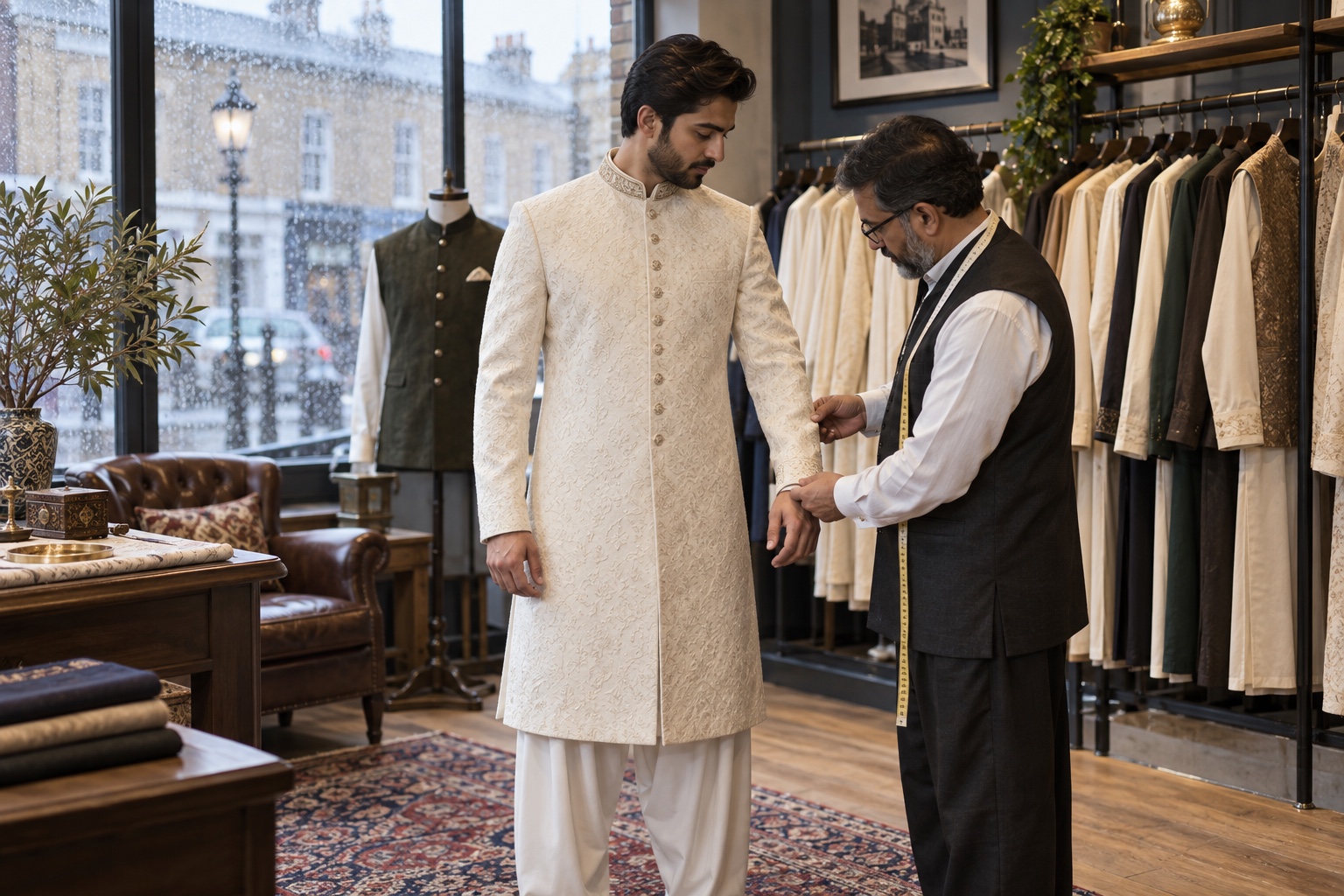
A long sherwani visually extends the torso and can overwhelm a shorter wearer if the hem and flare are not adjusted. A shorter achkan or prince coat exposes more trouser and can feel lighter.
Final length should be fitted to the person, not copied from a taller model's product image.
Closure and overlap
Some coats close edge-to-edge with buttons; others overlap slightly or use concealed fastenings. Overlap affects chest room and the way embroidery aligns.
Fasten every button at the fitting. A coat that only looks good open is not successfully fitted formalwear.
Structure and interlining
Formal coats may contain canvas, fusible interlining, shoulder support and lining. These layers create shape but also add heat.
For a British winter wedding the structure can feel welcome; for a summer event in Lahore, fabric and lining choices matter enormously.
What to wear underneath
Sherwanis and achkans are commonly paired with kurta and churidar, straight trousers or shalwar depending on cut. Prince coats often sit comfortably over a simple kurta.
The underlayer should not bunch at the shoulder or create a second stiff collar under the coat.
Embroidery should follow the garment's architecture
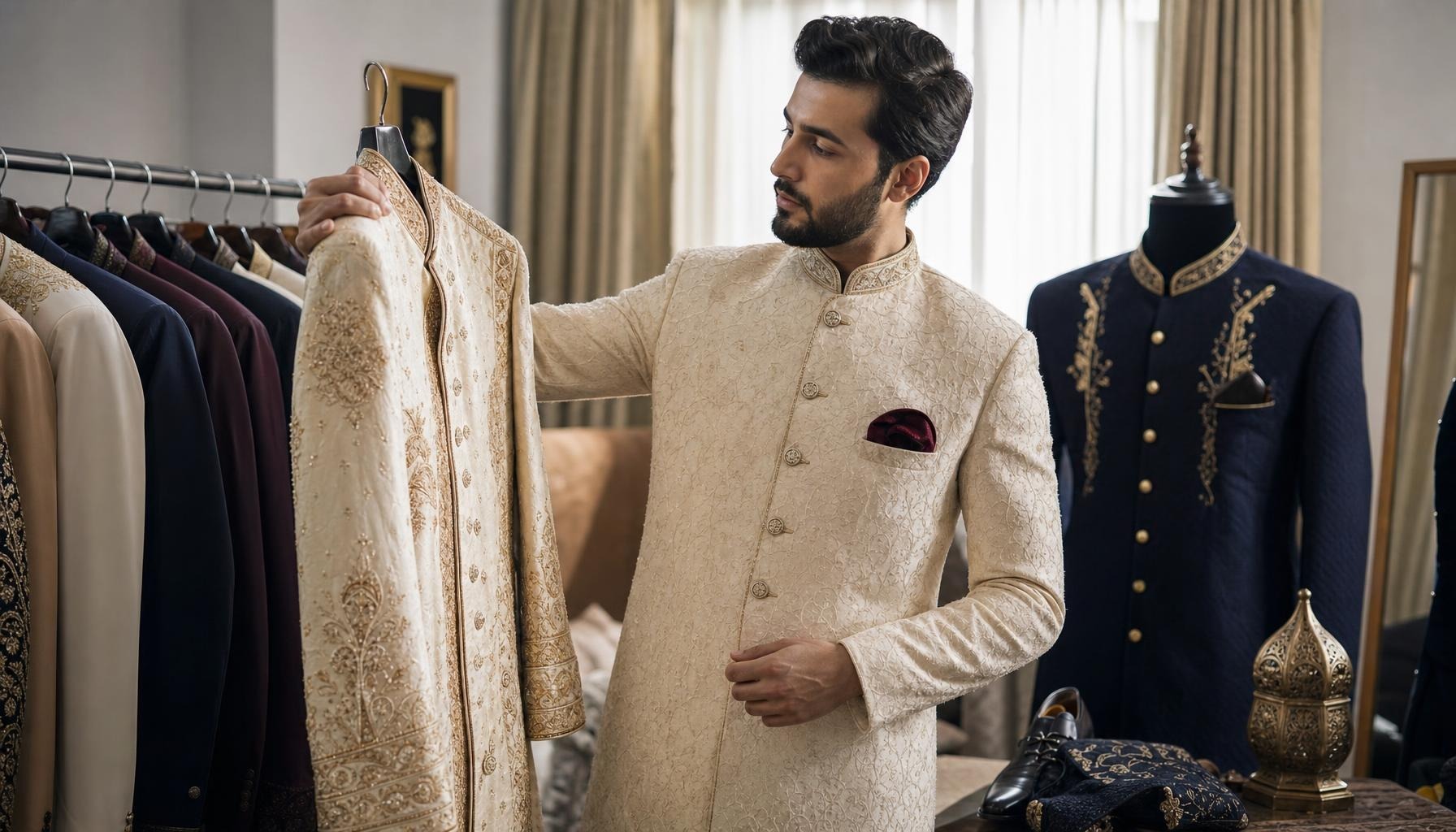
Dense work at the collar, placket and chest adds visual weight. On a shorter coat, the same amount of embroidery can feel busier than on a long sherwani.
Choose embellishment after deciding silhouette, not as a substitute for deciding it.
Groom, close family or guest
A heavily worked sherwani communicates groom-level formality in many contemporary Pakistani weddings. Guests can wear plainer versions, achkans or prince coats without competing with the couple.
Family dress codes vary, so ask when the event is highly coordinated.
The fitting test
Sit, raise the arms, close the coat and walk up stairs. Check that side vents open cleanly and the hem does not pull backwards.
Formal menswear succeeds when it looks controlled without forcing the wearer to move like a mannequin.
What the evidence can and cannot tell you: Sherwani, achkan and prince coat
Historical garment terms overlap across regions and periods, while contemporary Pakistani retailers use them flexibly. This guide therefore describes common modern silhouette tendencies rather than claiming one dictionary definition can settle every garment.
For sherwani vs achkan vs prince coat, the most useful approach is to separate verified material facts from shop language, inherited terminology and aesthetic preference. Where a label has a legal or technical meaning, read the fibre or product disclosure. Where the term is cultural rather than standardised, ask the seller what construction, material and process they actually mean.
A practical PakStyles checklist: Sherwani, achkan and prince coat
- Choose silhouette before embroidery.
- Fit the shoulder and collar first.
- Check full closure while sitting and standing.
- Try with the real trousers and shoes.
- Account for lining and climate.
The easiest way to choose among sherwani, achkan and prince coat is to stop asking which name sounds most formal and look at the actual line: how long it is, how much it flares, how it closes and how comfortably the wearer can spend a whole wedding inside it.
A better comparison method: Sherwani, achkan and prince coat
When comparing two options around sherwani vs achkan vs prince coat, use the same criteria for both: material, construction, dimensions, care, comfort, origin, expected lifespan and price. Marketing categories become much less confusing when every candidate is placed on the same practical grid.
The reader's final decision: Sherwani, achkan and prince coat
The strongest reason to learn about sherwani vs achkan vs prince coat is not to police other people's terminology. It is to make a purchase, styling choice or care decision with fewer surprises. Technical knowledge should create flexibility rather than another authenticity exam.
How to separate the name from the material reality: Sherwani, achkan and prince coat
With sherwani vs achkan vs prince coat, the first useful habit is to separate the market name from the physical object. Retail and cultural vocabulary can carry history, prestige and regional meaning, but a buyer still needs to know fibre, construction, dimensions, finish, weight, fastening or production method where those details affect use. That distinction prevents a descriptive word from doing more work than it can support.
Specific to sherwani, achkan and prince coat, For a practical purchase or styling decision, write down what the object must do before judging what it is called. A shawl may need warmth without bulk, a dupatta may need grip, a formal coat may need to survive six hours of sitting and movement, and a textile may need to tolerate ordinary cleaning. Those jobs are measurable even when terminology overlaps.
What a trustworthy seller or maker should be able to explain: Sherwani, achkan and prince coat
A strong seller response to questions about sherwani, achkan and prince coat should become more specific as the price rises. You should be able to ask what the material is, where it was produced, whether work is hand or machine made, what dimensions are supplied, how the item should be cleaned and which parts of the description are traditional names rather than regulated specifications.
For readers using this menswear guide, Vague answers are not automatic proof of fraud, especially in craft markets where terminology is inherited informally. They are, however, a reason to reduce certainty. If a high price depends on hand work, rare fibre or regional provenance, the seller should be able to give evidence proportionate to that claim rather than repeating the same luxury adjective.
Why photographs can mislead even when they are not edited: Sherwani, achkan and prince coat
Campaign photography changes how sherwani, achkan and prince coat is perceived. Studio light increases sheen, pins create temporary drape, steaming removes handling marks and model proportions can make a garment or accessory appear lighter, longer or more structured than it will in ordinary use. None of that requires deceptive editing; it is simply the difference between styling and specification.
How climate and diaspora use change the decision: Sherwani, achkan and prince coat
Pakistani clothing and craft products often move between climates. sherwani, achkan and prince coat may be produced with Lahore, Karachi, Multan or Peshawar conditions in mind and then worn in Birmingham, Manchester or Glasgow. Heating, rain, winter coats and long indoor events change what feels practical even when the cultural setting is the same.
Handmade variation versus poor quality: Sherwani, achkan and prince coat
Hand production connected to sherwani, achkan and prince coat can leave small differences in repeat placement, stitch tension, dye tone or surface finish. Those variations may document process rather than negligence. The useful question is whether the variation is structurally harmless and visually consistent with the making method.
Care is part of value: Sherwani, achkan and prince coat
The cost of sherwani, achkan and prince coat is not only the checkout amount. If the item needs specialist cleaning, careful flat storage, tissue padding, regular repair or a climate-controlled place to avoid damp, those demands belong in the ownership calculation.
Specific to sherwani, achkan and prince coat, Keep the care label, seller instructions and spare material together. For formalwear and handmade textiles, photograph the piece before the first clean and save details of any alteration or repair. That record can extend usable life and makes future professional care less guess-based.
How to judge authenticity claims without becoming a laboratory: Sherwani, achkan and prince coat
Most consumers cannot chemically identify fibre or date a textile at home, and they should not be expected to. For sherwani, achkan and prince coat, use several modest signals together: accurate labelling, plausible pricing, maker or region information, construction details, clear photographs and a seller willing to answer technical questions.
For readers using this menswear guide, Avoid destructive home tests on valuable items. Burning fibres, scraping metal finishes or applying chemicals to dye can damage the very object you are trying to assess. If a purchase is expensive enough that exact authentication matters, independent expertise is the proportionate next step.
What modern adaptation gets right: Sherwani, achkan and prince coat
Contemporary versions of sherwani, achkan and prince coat can simplify production, reduce price, change fibre or adapt the format for new wardrobes. That does not automatically make them culturally empty. Living traditions survive partly because makers and wearers change how forms are used.
Sources and official profiles
Filed under
Was this helpful?
Keep reading
Related stories
More from this desk, this beat, and the tags on this piece.

Readers
The conversation
0 notes
Anyone can leave a note. Guests add a name and email — no account required, and the email is never published.
No notes yet. Yours would be the first.